
 Get started
 Log in
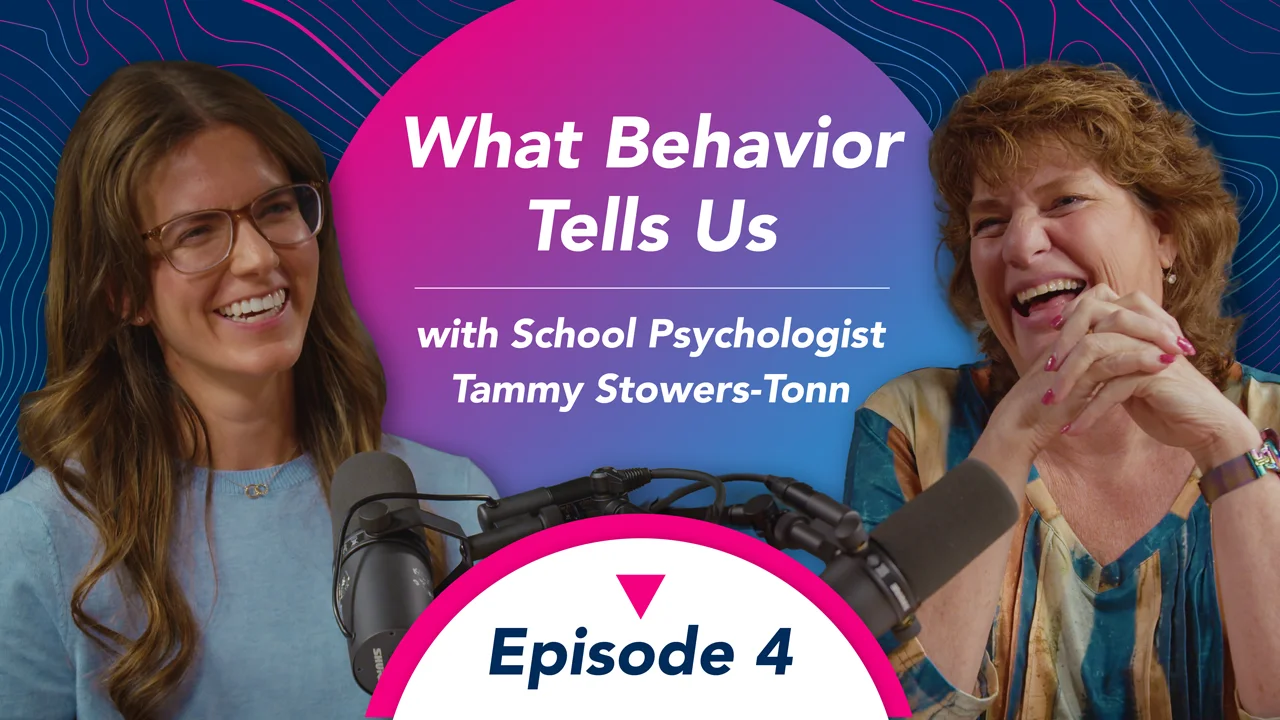

What Behavior Tells Us (ft. Tammy Stowers Tonn, school psychologist)
In this episode of EdTech Explored, school psychologist Tammy Stowers-Tonn joins us to discuss why behavior is communication, how student needs have changed over the years, the impact of technology and social media on wellbeing, and what educators and families can do to better support students.
Transcript
Erin: We're used to talking about edtech and student experiences at scale. That is, from the district level. But what about the complex and developing internal worlds students bring with them every day to school? To see and take care of the whole child requires a certain special set of skills, one that you can find in a school psychologist. Welcome to EdTech Explored, where we talk about all things edtech: what's working, what's changing, and what educators need to know to stay ahead. I'm Erin Werra, and I'm here with my wonderful co-host Lauren Pozorski. Today we're joined by our fabulous guest Tammy Stowwers Tonn, who is a semi-retired school psychologist. Today we're talking about kids’ well-being balanced with their school responsibilities, and how technology could play into that.
Lauren: Welcome to the show, Tammy. We're excited to have you.
Tammy: Thank you. I'm excited to be here.
Erin: So, kids arrive at school with way more than backpacks, as we know. Students may have all kinds of weird stuff going on in their heads, and we really don't know about it until they feel comfortable sharing it with us. I remember when I was in school, I was so upset about getting a C on a spelling test because it meant I couldn't be in the school play. In my head, this was obviously not true. But these unseen things that kids bring to school with them have an impact on their learning, and as a school psychologist, you're an expert in that mental and emotional growth.
Lauren: Before we get into our first question, can you start by telling us just a little bit about you and your background and your career so far?
Tammy: Sure. So I started out as a school psychologist in 1991. I was hired by CESA 5 out of Portage. It's a cooperative that provides services to smaller school districts that can't afford their own school psych or occupational therapist, things like that. And at that point, it was very typical for a school psychologist to service several school districts, and so I was in three different school districts in three different directions in the state. I was on the road a lot. The more difficult part about that is because you're only in a building one day, or a district, one day a week or two days a week, you really don't get to know anyone. You're just seen as the person that comes in and tests students for special education needs. You're not really seen as a resource for the school district. And as somebody that's more extroverted, it's hard to not be part of that community. So that first year was difficult for me.
Tammy: After that, I was placed in Necedah where I spent the next 15 years, which was a fabulous place to be. One school building, so I was spoiled: 4K through 12, and I never had to leave the building. It was a great dynamic there. They kind of went through my early years of raising children and all the things, so you become a family when you go through that stuff. Then from there, I became a special education director. I would go out into different school districts and support school districts mostly with legal-type things and more difficult cases that involved maybe parents who were struggling to understand the process, or the school and the parent maybe didn't see eye to eye. So I would help mediate that. I did that for three years.
Tammy: Then Westfield was a school district that I was the director in at the time, and they also needed a school psychologist, which I had a license as a school psychologist. So I went to Westfield as their director and school psychologist, and I did that for the last 16 years. I retired at the end of last school year after 35 years and came out of retirement to help in the school district of Stevens Point. I started in Jefferson Elementary this last year, which was an amazing experience, and this coming school year I'll be at Washington Elementary.
Lauren: And are you working with kids K-12?
Tammy: My entire career has actually been three-year-olds through seniors, sometimes up through age 21. That's what we're licensed for: 3 through 21. However, this last school year, I was in one building, whereas I come from experience of being in five different buildings. At this school, there was pre-K through sixth grade, but there are psychologists for 3K and psychologists for 4K, so I just worked with kindergarten through sixth grade, which was unusual for me. I'm used to having the whole gamut. So yeah, it was wonderful in one school building.
Lauren: So, school has changed a ton since you first started. Can you talk about some of the changes you've seen and how those changes impact the whole child?
Tammy: It's a great question, and change almost seems like an understatement. When I first started out, everything that I did with evaluation reports and meetings with parents was handwritten. My reports were done on a typewriter with a lot of whiteout, until I got the typewriter that had the little white tape in it. That I thought that was a pretty big deal. The times that we met with parents were all handwritten, and at the end of the meeting we would rip this triplicate apart and hand one to the parent, one stayed at school, and one would go to CESA. From that to then getting computers and using floppy drives and then the smaller discs, and just that progression. Getting a phone at my desk was a big deal. Getting answering machines was a big deal.
Tammy: All of that was done with the excitement of saving us so much time. But anytime I saved from being able to use technology, I lost because that phone was now on my desk, or the voicemails, or just being available when needed. That took some time away that maybe I saved. Now everything that we do is web-based. Even the phones are web-based. If I'm at home and someone calls my desk phone, it comes through my computer. Text messaging, which I do love because nowadays no one picks up their phone, it’s very unusual for anybody to pick up. So a lot of my correspondence is text messaging with families, which I like because it's convenient for them. They can respond on their lunch if they're working, or a lot of our families are sleeping during the day because they work nights, so it’s more convenient for them. But if someone would have told me 30 years ago that I was going to be sending a message through my computer to their phone, I would have laughed, like, what are you talking about? You know, this isn't The Jetsons people. So, I just dated myself by saying that.
Erin: Well, good thing we grew up on The Jetsons.
Tammy: Thank goodness.
Erin: So, talking about all of these different types of technologies that you used to do your job, do you think those have an impact on students, and do they have an impact on their social-emotional learning?
Tammy: One hundred percent. Probably 10 years ago, it was still books in front of students, workbooks, and that still exists. But now there’s many schools have one-to-one, so every child has a computer, and much of their day is spent on the computer. Then these same children are going home, and some environments are still screen-heavy at home as well. When you ask about social-emotional, what comes to mind is that before technology, what was happening at school stayed at school. We could go home and tell a parent or grandparent what happened at school, they could talk it out, and then it was kind of done until maybe the next day. Now with technology, it just continues. Whether it's cyberbullying that you hear so much about or just that it can be relentless. So that's a piece of it that I struggle with the most. It can't end at school, and then they get home, and it’s home environment where they feel safe. Where now all of that it follows them. That concerns me.
Tammy: I'm seeing a change in students’ problem-solving skills. If they don't know something, and I find myself even doing it sometimes, instead of just working through it, I'll go to technology because I want to get there quicker. But I have the stamina to do the harder things, whereas children coming through and learning those types of things I’m seeing their problem-solving skills become less and less, which then impacts their stamina to do hard things because it's all right there. When hard things and it become hard, their frustration level rises, they get frustrated, and then they're done. To try to encourage them, that is the impact I see technology having on our kids. It's more significant than anything else.
Erin: That's really interesting when you break it down to those types of skills.
Tammy: I worry about that. What makes us have work ethic is the ability to do hard things and the stamina to keep going until we can figure it out. And I worry what that's going to look like if we continue at the pace that we are.
Lauren: You mentioned that 24/7 aspect, where they have the technology, they're on screens at school, they go home, and it's more of the same. What can schools and families do to help set boundaries to make sure that it's not something that is going to have a negative effect 24/7?
Tammy: Right. And, it’s only from what I observe. What I would like to see happening is when I go to the grocery store, instead of parents saying, “We need some bananas. Can you find the yellow bananas?” I'm seeing kids in the front of carts on a phone or screen. We're missing out on that language piece with kids. We're not just speaking to the kids, and all of that is brain development. When we're out at restaurants, just looking around, the adults are on their phones. The kids are on their tablets. And I know why. I 100% know why. If kids are not behaving in public, parents feel like it's a reflection on them. I've got two adult children, so I understand that feeling of poor behavior means, “I'm a bad parent.” That feeling we’ve had. But how are kids going to learn to handle all of that and how to behave and what types of things are acceptable and not acceptable if we don't put them in positions to deal with it? And putting a tablet in front of them is not the way to do it.
Erin: Can technology ever support us in learning how to become human together and getting those SEL skills in?
Tammy: Yes. In fact, there are some great programs that we use in the school system to assist with that. I think technology is just that: it should assist us, not be the only thing that's going to teach us the skill. It's an assist to the adult interaction and the adult modeling of the behavior that we want to see. We are the best teachers, whether you're the parent or the teacher, and technology just cannot replace that. So I do think it can be a help though.
Erin: Okay, and so when you’re using technology. I’m just thinking back to filling things out by hand in triplicate, that's really tough when you scale that up because we are talking about individual students and what's going on in their lives, but you're also serving students at scale across many districts. Do you find that documentation has become easier, or are there more barriers now?
Tammy: Documentation is so key to helping that child. Everything from documentation from the teacher on what they're seeing in the classroom, from the parent, what they're seeing at home, and then what we see from the full day of the child navigating the school day. Putting that all into a report is time-consuming because you want it all to mesh. But more importantly, at the end of all of that, you want to give recommendations and “Here's how we're going to help.” I know when I supervision, things like that, with special education teachers and all the evaluations that are done, I often say them, coming to the table and saying, “Your child is struggling in reading,” or “Your child is struggling with this behavior,” is why we're here. There needs to be another level: because of these struggles, we are going to do this, and here are some recommendations. I feel like that piece is missing, but technology can help with that.
Tammy: I know there are differing opinions, but using artificial intelligence to help with problem solving, especially when you're the only school psych sometimes in a district, you can put into AI: “I have a child who's doing X, Y, and Z in this type of environment. The child likes these types of rewards. What are some recommendations?” And it will give you some recommendations, and that is helpful. So, I see that there’s bits and pieces of technology that could assist with report writing, and save some time, to do all the data collection that you need to do.
Erin: Because there are so many districts, there is maybe less than one school psychology person in the district. So being able to have that support as a staff member, but also, I'm really interested in the school-to-home connection because we know that the challenges are moving from school to home and back very fluidly. But these plans that school psychologists make for families, how do they keep up that engagement with families and check in on those? We see and document what's happening in school, but what about the family connection?
Tammy: We have so many different definitions of families right now and what that looks like and what the home looks like for the child. So I'm always very cautious about what I'm suggesting to families because I can't certainly assume that there are going to be two adults in the home, or even an adult. It may be an older sibling. What can I expect and encourage the family to do that won't just add more stress? Because when you have a child that's struggling with learning or struggling with behavior, that alone is stressful. It kind of changes the whole dynamic of what you had planned for your child, and so navigating that piece with the parent and walking the journey with them on just that alone takes some time.
Tammy: So it's mainly just asking the parent. And I often do that when I'm interviewing them, because I always interview the parent either on paper, over the phone, or face to face about their experience. Oftentimes my question to them is, “Who's taking care of you? Who do you talk to?” Most of the time it's, “No one's taking care of me,” or, “I'm fine. I don't need anything.” So I try to be that person that they can call when they need somebody to say, “This is going on. I don't know what to do.” And then I help them with resources. That's how I try to make the connection between home and school, is meeting the parent where they're at. Because once they feel like there's a connection, they will be more open to listening to what I've got to say about their child.
Erin: Absolutely.
Tammy: So, that’s kind of been my thing.
Erin: And those examples, and walking through that, really drive home how school districts are taking care of their entire community. It's a lot of pressure.
Tammy: Especially for teachers. You had mentioned earlier about kids coming into school with their backpacks on, and I liked you saying that because I often refer to that: many kids who walk in that door already have their backpacks already full of emotional stuff. They're already dysregulated because they didn't get breakfast, or things didn't go well, or they were being hollered at because they weren't getting dressed quickly enough. And so, they're coming in with full backpacks. But what we also don't realize or think about often enough is that all of us are coming in sometimes with our backpacks full. Many teachers are showing up to work with lots of stressors on their plates, and they're being told, encouraged to establish relationships with this child, and that should help their behavior, and do all the things, be all the things for the child. But are we being all the things for that teacher so that they are available to be all things for their child? I hope that's some of the role I play too, is to be available for staff. But we have to remember that staff have backpacks too, and they're awfully full and overflowing. We're expecting a lot out of them.
Erin: I agree completely.
Lauren: That's a lot of people you're serving though between the student population, the educators, the families. There’s a lot of different people you're interacting with and helping in your role.
Tammy: And I love it. I love it.
Erin: Is there anything that we can talk about? What's the healthiest part of schools today for students or for staff?
Tammy: The healthiest part would be relationships. No amount of curriculum, no amount of technology cannot replace relationships. I would hope that every child who comes to school has a healthy relationship with peers as well as an adult. At least one adult. If I'm writing any plans, I always put in the plans who is responsible for something, and I will put “classroom teacher or trusted adult, another trusted adult.” I always encourage parents to ask their child, “If something's not going well, if you need to talk to somebody, who can you talk to at school?” There are some kids who will say, “No one.” We hope that's few and far between, and those are the kids we want to know about so we can help them up to make sure they have a trusted adult. Those are the things I believe are the healthiest, or what we should strive to be the healthiest in schools, is just the relationship and meeting kids at the door with a high five, a fist bump, or a hug.
Lauren: So, you have a unique perspective as a school psychologist. For any educators who are listening to this podcast right now, what’s something that you would like them to see from the perspective of someone who does psychology for a living?
Tammy: What I always come back to is that behavior is communication. Every time there's behavior, whether it's an adult or whether it’s a child, they're trying to tell you something, but they don't have the skills to express it with their language, or they just cannot do it. We have to be better listeners to that behavior. I work with so many wonderful colleagues that really do an excellent job of that, but I wish everybody would see that behavior as communication and not just a child trying to be a stinker.
Lauren: Absolutely. And like you said, it's the case for adults too. It's something we all can keep in mind, behavior is communication. If a behavior seems off, there's something that person is trying to communicate.
Erin: Maybe asking that question.
Lauren: Exactly.
Erin: Something I keep hearing you say is that students are coming to school and they are not regulated. Can we talk about what a regulated student looks like, feels like, and what they're capable of compared to a peer who is not regulated?
Tammy: Believe it or not, that's not an easy observation. What I like to describe is getting to know your child's, or your adult, whoever you're dealing with. It could be your assistant in your classroom. Could be a co-teacher. Get to know their baseline. For example, my baseline. The secretary I had for many years. If I was quiet, she knew, something must be going on because I rarely was quiet unless I was in a meeting or something like that. So get to know the child's baseline. So, if they're typically quiet and more reserved and all of a sudden they're not. Dysregulated, you know, have a conversation or, not about what’s going on, not pointed like that, but just try to redirect. Or if you've got a child who's constantly, you know, a mover and a shaker, and all of a sudden they're not, that then also is telling you something's not quite right.
Tammy: So, maybe my expectations for that child will look different. I'm not going to bring the rigor down, and I'm not going to allow poor behavior, but I might ask, I might wait a bit to ask them to do something that might be difficult if I notice they're off baseline. Same thing with an adult. If we're married, or significant other, and we see they're off baseline, now might not be the time to bring up a more difficult conversation. It kind of goes across all ages. My bottom line is, if you see they're off baseline or they’re dysregulated, change your overall expectations for that moment. Provide them a safe place. Provide them a time, and know them well enough to know what does regulate them or what brings them back to baseline. Then start from there for expectations.
Erin: How do you know, in your role dealing with such personal things, what are signs that you've made an impact on a student's life?
Tammy: I think the two things that have always spoken to me or help me determine whether I made an impact are these one, if I'm providing some sort of feedback. If the person says, or even the child says, “I hadn't thought of it that way,” that is like gold to me. I just love that because that's all I'm hoping to do. Most times, people know what they need to do. They know the right thing. They know, in that situation when it's just the two of us, they know what they should have done. They have the right answers. But in the moment, when emotions are high, sometimes you kind of have “rock brain,” as we like to call it with kids. You're in the wrong part of the brain, and I can't problem solve right now. So when I hear someone say, “I hadn't thought of it that way,” that is just I love that.
Tammy: The other part is that such a big piece of my role is working with special education students and identifying them as needing special education. Walking that path with the parent matters, because parents have a plan in place for that child, and now that plan looks different for them. I also tell them, “Now you can see your child through a different lens. Not a lens that's bad. It’s just different.” Now there's an explanation for the behavior. There's an explanation for the frustration. And get them to look at it that way. Over the years, between academics and behaviors, there’s been so many kids and so many children who are cognitively delayed but they’ve got hearts as big as Wisconsin. In the end, it's all about how we are going to see this child through a lens of success. How are we going to get this child from where they are right now so they're productive in society and they’re happy? If that happens, then I know that I was successful, or we were successful and I was part of that team.
Lauren: What would you say is your favorite part of your job?
Tammy: My favorite part of my job is when we are sitting around an evaluation meeting. I typically lead those meetings, and then I go around the table and we all give our testing results or what we've come up with. The best part is when the next person says, “That's exactly what I saw, and my testing shows this.” It's almost like putting a puzzle together, and every piece is going in perfectly. By the time we're done, we've got an intact puzzle, and we're ready to go to the next steps with a plan for that student. That is just the best part. I have to say, that's usually what happens. We usually, by the time we get around the table, we've spent enough time with the student and we're able to do that. It's good for the parent too, because they're seeing a group of people who really know their child. That's probably my most favorite part of my job, but I like a lot of it.
Erin: What's one thing you look at in schools today with students that makes you think the kids are all right?
Tammy: I think the rigor academically that is provided, just in the elementary school I was just at and I'm certain in the next elementary school I'll be in, the rigor and expectations of academics is spot on. In fact, it's incredible the things that I remember learning in fourth grade, like multiplication timed things, are happening in first grade. It's amazing to me, that the expectation’s at an earlier age. Academically, they're getting their needs met.
Erin: That is wonderful. It sounds great. I heard that in your answer earlier: at no time are you looking to decrease the rigor for students. You're always wanting them to learn what they need to learn. They may just approach it in a different way. They may need a scaffold, just like that, but you never bring down the rigor.
Tammy: Right. What I was going to go on to say is that the part I probably worry about — is that okay?
Erin: Of course.
Tammy: Is that executive functioning came up a lot this year. And what that is, is that there’s different ways of planning for things. There are different areas of executive functioning that affect everybody, but affects more often people with attention deficit disorder or when you’re not regulated. Things like that. And I would like families and educators to maybe assist with that more.
Tammy: The best example I like to give — and anybody who's worked with me the last few years has heard this example — is to have your child make a peanut butter sandwich. Most times, if I want a peanut butter sandwich, by the time I get out of my chair and to the kitchen, in my brain, that sandwich is made. On the way there, I'm thinking, “I have to grab the bread, the knife, the peanut butter, and a plate.” Students who are struggling with executive functioning, nothing happens until they get to the kitchen. Then you hear kids saying, “Where's the bread? Where's the peanut butter?” And parents want to be helpful, so sometimes they're not making kids figure it out.
Tammy: Start practicing early when your kids are little. Have them run into their bedroom and get the socks and the clothes. Have them follow two-step directions and three-step directions. Have them work on executive functioning skills so that when they get to school, they are able to organize their homework. They’re able to organize their behavior. They have the capacity to do it. That's another thing I don't think technology is helping, because everything is so immediate, and they don't have the skills for executive functioning. Now we're finding that is almost a disability in some kids, and it wouldn't have to be if we could start that sooner to help them with their “peanut butter sandwiches,” so to speak.
Erin: Yeah, in your example, you walk into the kitchen and start asking, “Where's this? Where's that?” It's like prompting a chatbot. It's interesting to see the difference there, in that the sandwich is already made in your head, but we get to the kitchen, start asking questions.
Lauren: That's a great example to illustrate that.
Tammy: The other part is that sometimes we forget the mental math that needs to be taking place. We can do that with kids in the morning: “We need to be on the bus by 6:50. What time do we need to get up? What time do we need to brush our teeth? When do we have to be dressed by?” We should be talking out loud and having kids listen to us do that math, so they can start that planning. Oftentimes kids are getting up and nothing's done, and parents are yelling, “Come on, we've got five minutes. I told you to brush your teeth.” There are all those things we can work on to help that whole executive functioning piece that I'm seeing struggle with so many kids now.
Erin: I think my last question for you, if you had to look in your crystal ball and anticipate what the future holds for K–12 students, what do you think that looks like right now, and what should their leaders focus on?
Tammy: I see this even in my adult nieces, nephews, and my own children, it's less and less with their phones. So I do think the pendulum will swing back, and we will find ourselves moving away from technology as much. You hear that talk now, that they're moving away from one-to-ones in some schools. So, I do think we're going to be fine, but we're going to have a period of time here where we're gonna have to do more educating, problem solving, and social skills work. But my crystal ball tells me we will get back on track and we will be okay. I already see it swinging in that direction.
Erin: That's interesting.
Lauren: That's good to hear.
Tammy: I hope so, anyway. Hopefully in my time too.
Tammy: We're kind of learning a new normal, and it's interesting to be in the middle of learning that new normal.
Tammy: Right. I've often said I'm so glad I raised my children during a time when we did not have technology. I'm glad I didn't have to navigate that along with navigating everything else about being a parent.
Erin: I've even heard from younger colleagues that because they grew up with the internet and social media, they think about their behavior differently. That's interesting to me.
Erin: Thank you so much to our wonderful guest, Tammy, for sharing all of your insights and advice for districts that are looking to serve the whole children in front of them, not just the mythical child. So, if you enjoyed this episode, you can follow and subscribe to our other episodes on Spotify, Apple Podcasts, or wherever else you listen. You can find this episode and others at skyward.com/podcast. And you can send us your questions or volunteer to be a guest at podcast@skyward.com. Thanks for listening, and we'll see you next time.


 Share this video