
 Get started
 Log in
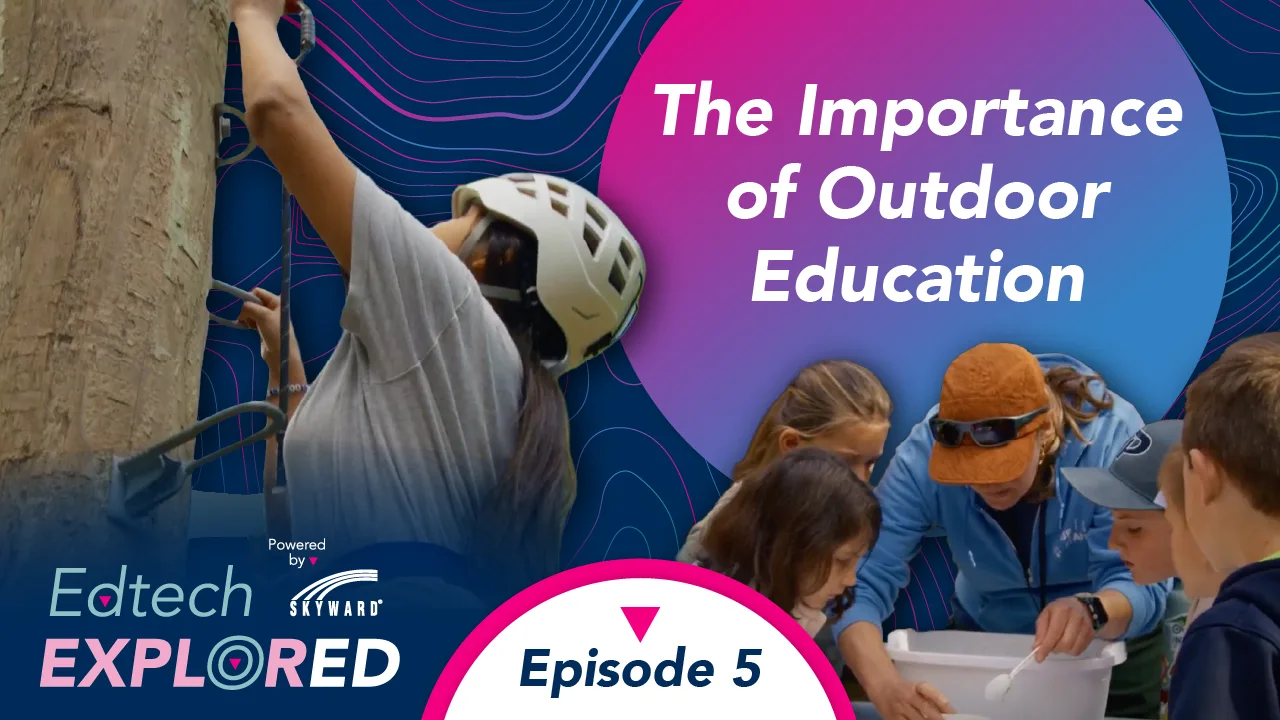

The Importance of Outdoor Education
In this episode, Lauren and Erin explore outdoor education through two perspectives: the curiosity of children (because, surprise, they were kids once too!) and the observations of adults. Lauren has taken a trip to the Tomorrow River Community Charter School and Erin visited The Boston School Forest in Stevens Point Wi. Together, they discuss what makes outdoor learning so impactful and the lessons they brought back from both visits.
Read our article about outdoor learning:
https://www.skyward.com/blogs/ak12/2026/april/outdoor-learning-is-a-solution-hidden-in-plain-sight
Watch a video about the Boston School Forest: https://youtu.be/Dk8kImgjPvM
Watch a video about the Tomorrow River Community Charter School: https://youtu.be/M7qPThKjJ1k
Lauren: Archery, high ropes, and wood carving may not sound like traditional classroom activities, but in outdoor learning, they make regular appearances. Which brings us to the question, do kids learn better outside? Welcome to EdTech Explored, where we chat about all things edtech: what's working, what's changing, and what educators need to know to stay ahead, I'm Lauren, and I'm joined by my co-host, Erin. And today we're going to talk about outdoor learning for all ages. So Erin, you were a child once. Did you have any outdoor learning experiences growing up?
Erin: You know what I did? I was very fortunate to be able to attend an overnight outdoor learning experience. Um, it was later in elementary school, and I was in a district that had many rural schools. So, a grand total of four girls in our fifth and sixth grade classroom. And so we were all invited as part of our district to go and have this outdoor learning experience together. And so we were able to stay overnight, do campfire stuff, hiking, canoeing, and then also meet some of our peers from within the district, and we would soon go to the middle school together. So, while it was more of an event than an outdoor learning curriculum built in, it certainly was an opportunity. How about you? Did you do any outdoor learning when you were a kid?
Lauren: We would go to the Central Wisconsin Environmental Station or SWES as it was called and we did a few field trips there over the years where we would get to learn about different animal tracks and go hiking through the woods and look at plants and do things like that. I remember there was a lake there and just getting to learn about stuff that you learn about it in the classroom, but then getting to see it in real life was a really cool experience.
Erin: Yes. And not one that every kid has in their family life. And I have a uh learning space that I want to talk about today that I was fortunate enough to visit with students and teachers. And you have a space that you were fortunate enough to visit with students and teachers. So, can you tell me a little bit about the school that you visited that uses outdoor learning?
Lauren: Yeah, so I went to the Tomorrow River Community Charter School. It's part of the Tomorrow River School District in Amherst, Wisconsin. And it was such a cool experience getting to go there for a day. The first thing I thought of when I got there is you've seen the '90s Parent Trap movie with Lindsay Lohan.
Erin: Yes.
Lauren: Okay, so picture Camp Walden.
Erin: Okay.
Lauren: That is what I loved that movie growing up. So, of course, that's what I'm going to think of. But I just when I got there, I was like, Camp Walden. This is real life Camp Walden.
Erin: So, it felt like a summer camp. It did, but it's not a summer camp.
Lauren: It did. Yeah. So, it's got little cabins all around. The classes meet in these — it's kind of the principal described it as that one room schoolhouse feel. So, each class has its one room schoolhouse where they meet and they have all of their classes there slash outdoors. Some of them, instead of cabins, it's a yurt. So, they're actually going to school in a yurt. There was a cooking class going on in the yurt while we were there. And um yeah, it just, that's the best way I can describe it, is it felt like a summer camp with all of the different cabins and the kids going between them. And it was definitely a very happy, energetic place.
Erin: Oh, that's wonderful. And like mine was a summer camp, too, that they took us to. But these kids aren't at camp. They're going to real public school. Is that correct?
Lauren: Correct. Yeah. So, it's fulltime school there. They can go there through 8th grade. And you know, you get there in the morning and there's the line of cars with everyone dropping their kids off at school, but then the kids are off running through the woods down the trails to their classrooms. Definitely not like a traditional school morning, but it for them this is their traditional school.
Erin: That's amazing. It sounds like a beautiful chaos in a way.
Lauren: That's a great way to describe it.
Erin: So what is a day in their life like at the Tomorrow River Community Charter School?
Lauren: So they're going to incorporate some elements of Waldorf education. So one of the things that Waldorf schools focus on is educating the whole child. They talk about hands, head, and heart. So engaging all of the aspects of the child. And so that's something they really try to incorporate from an early age through 8th grade at this school is doing things with their hands. They are, they were whittling chopsticks while we were there. They're doing various wood carving activities. They're painting. They do things with beeswax and things that they can really feel with their hands. The head. They are they're problem solving. They're writing plays. They're directing plays. They're doing math and more traditional aspects of school. And then the heart, there's music. There's, you know, fun activities outside. A lot of music. I will say there's ukulele, violin, um, guitar.
Erin: They're making music. They're not just taking in music.
Lauren: Exactly. So yeah, it just really incorporates all of those elements as opposed to focusing specifically on um those traditional school subjects with maybe an occasional, you know, music class or things like that thrown in.
Erin: So the overlap that I can talk about um the place that I visited is called Boston School Forest, and that school forest is part of the Stevens Point area public school district in Wisconsin. and they do not have children that go daily to the Boston School Forest. It's more not an event, but it's more of a field trip and they do um those types of outdoor learning activities that aren't necessarily learning about the outdoors, as much as they are practicing concepts. And the activities are set in the outdoors, but they are also learning real academic concepts and public school standards and they're practicing things that they may have learned in their traditional classrooms in the outdoors. And so in this place in Boston School Forest, it is a literal forest that you get off the bus and you walk into the forest. There are cabins, there are outbuildings, uh trailer classroom, um and then there's a pretty uh large amount of taxidermy as well, which I found out is a unique um thing to our area. Some students arrive and they have never seen a taxidermy animal. So, those are the types of things that they encounter when they get to Boston School Forest. Another really great part of this is the kids can touch it. It's not just something that they look at and observe. It's that sensory learning that you were really describing.
Lauren: Yeah.
Erin: And serving that whole child and giving them something to hold in their hands and explore that way. Giving them something to think about. Um, giving them something to observe with all five of their senses. Um, and that has a transformative impact on kids.
Lauren: Do the students go pretty much once a year throughout their entire time in the district?
Erin: They do.
Lauren: Okay.
Erin: And not only that, the way that the environmental educators at Boston School Forest have set that up is that students come back each year, and some of their activities build on each other. So in second grade, they're planting potato seeds in their specific school's um garden box and then in third grade they get to come back and harvest those and eat the potatoes that they planted.
Lauren: That's cool.
Erin: So building upon it, they get to know the area. They feel welcome there because that's what the educators are trying to do is to capture those students who maybe don't necessarily like school when it's in a building as much as they like it when it's outside. And those are the students that thrive in that sensory-filled environment. They can really find a sense of belonging that they might not find in traditional school.
Lauren: So on your visit there, what types of things were they learning about?
Erin: Okay, excellent question. So, we went on a day where there were second graders and seventh graders. Never did the two meet. They were in totally different parts of the woods. They wouldn't have even known each other, were there. But those second graders were really getting to know things on the ground level. They were playing a game about amphibian life cycles. They were observing pond creatures. And then the seventh graders were quite literally up in the air. They were 30 feet up on a high ropes course. And this is a component of sensory learning that also brings in all of these social emotional learning things like these are kids who are doing something that's kind of scary. They need to be brave. They ended up cheering each other on and encouraging each other. And then there was this really special moment that um Karla Lockman, the program director, shared with us later that there was a student named Hannah who was up 30 feet in the air and all of a sudden this family of baby chickadees joined her. They literally still had their fuzzy feathers on and they were just starting out their lives and she is eye to eye with these chickadees 30 feet up in the air. She's at school. She's learning. This is something that's not only memorable, it's unforgettable.
Lauren: I love that. Well said. I wish we would have had a high ropes course when I was in school. That's so cool.
Erin: Yeah.
Lauren: That's awesome. That's very fun and so special about the chickadee moment.
Erin: And it's very, very deliberate, intentional. Um these kids are always safe. Safety is one of the major components obviously when you're out in the woods. Um and then the last activity that I want to talk about is um archery. They were shooting arrows and so trying to get that bullseye on the target but also measuring the velocity of those arrows. So this is where like technology comes with them into the woods. They are using stopwatches. They're measuring that speed of the arrow and then they're calculating those types of scientific and mathematical concepts. Will everybody use archery in their real life job? Probably not. But you know that math concept can be solidified in this new outdoor setting which is very exciting.
Lauren: And it probably sticks with them longer than if they were just to do it all on paper.
Erin: Yes, I totally agree. And in fact, we were able to talk to students, and they said as much. They said, you know, this is something that sticks with me because I get to do it with my hands. I get to do something, putting together all of that, my brain, my senses, my hands, you know, and learning and being with peers and friends. It's a very, very special experience for them.
Lauren: Was there anything else that stood out to you from your opportunities to talk with the kids and what they said about their experience?
Erin: You know, I'm thinking a lot about those seventh graders who they're young, you know, professionals in a lot of ways, and they're very polished and they've learned a lot. So, I really want to also talk about those second graders who are a little bit more chaotic and they're experiencing things sometimes for the first time. They're also making connections for the first time of seeing like, oh, this bug has a job in the woods. And so, we are a little bit learning about just the outdoors itself, but we're learning about how the outdoors affects their world that they exist in every day. And so then how they can affect their world, which is such a cool concept for a kid who's learning how to be a person.
Lauren: Absolutely. Yeah.
Erin: So, is outdoor learning — and I don't know the answer to this and we won't know the answer to this — but is outdoor learning something that you can just do once a year and it sticks, or do you have to be immersed in the outdoors every single day for it to have an impact on your learning?
Lauren: I mean, again, this would just be my opinion on this, but I feel like it's one of those things where if you can do it once a year, great. And that's going to have an impact for those kids and they're going to cherish those days, and they're going to learn some really cool lessons while they're out there that they're going to remember. But if you can incorporate it on a semi-regular basis, or you know, whatever that looks like for each district. And that's going to that is going to vary for each district. You know it's going to depend what resources they have available to them. Not every school has a forest that they can go visit, you know.
Erin: That’s so true.
Lauren: But I think even those little elements of maybe holding a class outside for a day, reading books outside, doing a walk around the school where they get fresh air, and they get to experience things with their hands and their all of their senses. It's all going to help.
Erin: And that's something that the educators involved in both of these sites were really again intentional about. When kids first start going outside for outdoor learning. It can like there's an acclamation period where they have to go out into the woods and then be reined back in to focus and to learn. And so there is a deliberate practice of we're going outside, but we're still going to be doing our jobs. We're still going to be learning from whether it's resources or activities or reading like you mentioned.
Lauren: Yeah.
Erin: So, practicing going outside but not necessarily staying at recess mode. And I think that that is something that the environmental educators were really intentional about. And they had some really interesting rituals that helped get the kids from that. I just got off the bus and there's fresh air all around me and now I'm going to run to, hey, let's think about this arrow. Let's think about how fast it's going. Or let's think about this life cycle of an amphibian.
Lauren: Which is a good thing to practice, too. Being able to reel yourself in and go from fun outdoor excitement to focus.
Erin: That's so true. And where do we get to practice those types of things? I mean, there's transitions in every classroom, but they're not as extreme as let's go outside, and it might be pouring rain and 40° out. And we're still going outside.
Lauren: Yeah. Yeah. That's I'm glad you brought that up. Do the kids go to Boston School Forest regardless of the weather? I mean, we're in Wisconsin here. It can be 95 like it is today or it can be well below zero.
Erin: Yeah. No, it's a good question. And we were really fortunate to visit on a day that was 65 degrees and sunny and it really. If every day could be like that at Boston School Forest, it absolutely would be, but it can't, you know, and so um Karla Lockman, the program director, was talking about how when the weather gets extreme, they will limit their time outside, but they will not stop going outside. So, if you can go out for 20 minutes at a time and that's what's safe and then come back in um you know put on an extra layer of mittens and all of those things that they keep there so that students can show up as they are and then be completely um transformed into a Boston School Forest student.
That's exactly how it was at TRCCS as well. Rain or shine, they're going outside. Like you said, if it's miserably cold, they're not going to have the kids outside all day, but they are still going to.
Erin: You can go back to the yurt and have some hot chocolate.
Lauren: Yes. Exactly. Exactly. But yeah, they're still going to try to get them out in the elements. If it's raining, they'll bring rain jackets, but they'll be out there still learning in the rain.
Erin: Yeah. I think what is it a German proverb? There's no bad weather, only bad clothing. And so it makes children think about and confront their own limits that they've placed on themselves. And so I know at Boston School Forest and I can imagine at Tomorrow River Charter School that there's a really big focus on belonging. Every kid belongs at outdoor learning. And so we're meeting kids where they're at. We are welcoming, you know, the kid that doesn't sit still as well is thriving in a place where they're not expected to sit still as well.
Lauren: Every kid's going to learn better in different settings. The traditional classroom works great for some of them, but it's not going to be the best setting for everyone.
Erin: So, you know, speaking of traditional classrooms, they can be very tech heavy and technology is a part of keeping records about how students are progressing for academics and standards-based. How does technology fit into Tomorrow River Community Charter School?
Lauren: They increase the amount of technology they use as they get older. So, by the time they're in 8th grade and they're graduating from 8th grade and they're going to go on potentially to a traditional high school, they've used enough technology. They're ready. They can step in and flourish and be just fine with their tech use when they go on to a more traditional high school if that's the route they choose to go. So, it's it starts less, but it's not like they don't incorporate it.
Erin: That's kind of mirroring um trends that we're seeing emerge on the national scale. Like there is a push to have less tech for younger kids. And this is something that they're already doing.
Lauren: Exactly. It's about it's about that balance which is something we've talked about on this podcast before, too, where it's you know the tech technology is not going away, but if we can find that balance where it's there it's helping but it's not necessarily used to the point where it's having you know it's causing negative effects.
Erin: Sure. Or a distraction.
Lauren: Yeah, that's a good way to put it too.
Erin: I mean, it would be really hard to distract a kid from a super cool outdoor learning experience on a beautiful 65 degree day.
Lauren: Exactly.
Erin: But if anything could do it, it would be a laptop or a Chromebook.
Lauren: For sure. That's so true. Um, I was also just thinking back to when we were there. We interviewed a few of the kids and the kids would sometimes come up to us and they would just, you know, come up and chat with us. And I remember saying to my coworker Laura who was there doing the video with me like the kids are all just so good at communicating and talking and they're, you know, they're...I was just really, really impressed with their communication overall. They were just excellent communicators. And I brought that up to the principal when we were interviewing him, and he credited two things. One, he credited that low tech learning. He said because there aren't screens, they're talking to each other all the time. They're talking to adults. They're not hiding behind their individual screens in their own little world doing their own thing. So, he credited that low tech learning environment for their communication. But then he also mentioned that they do a big focus on presentation skills.
Erin: Okay.
Lauren: And he said by the time the students are in eighth grade they do a 1-hour presentation as part of their capstone which I was thinking back and I'm like man when I was in I think it was freshman year of high school it was like okay you have to give a 5-minute speech and I was like 5 minutes? And these eighth graders are giving 1-hour presentations which I thought was pretty cool to hear.
Erin: That emphasis to that level of presentation and communication is unique. Is there anything else unique about I mean aside from being set in a beautiful idyllic uh summer camp setting, is there anything else unique about how students move through the Tomorrow River Community Charter School?
Lauren: Idyllic is the right word to uh describe it. I don't think I added it's also situated on a lake, so you've got a lake in the background. So, it is just a very peaceful setting. So, um but yes, there is um something that's very, at least I wasn't familiar with other districts doing this. They practice looping. So, what that means is when the kids come into first grade, the teacher that they have in first grade will move with them to second grade to third grade to fourth grade all the way up through eighth grade. And then when those kids graduate eighth grade, that teacher will go back and they will start in first grade with a new group of kids.
Erin: Oh my goodness.
Lauren: And so, the kids are really getting to know that teacher. They're working with that teacher, and the teachers will do home visits as well to really get to know the kids’ families, where they come from, and they'll do those especially early on to make sure that they really know the students in their classroom. And again, I don't know how common that is, but it was something that was entirely new to me.
Erin: Well, it's something that's possible because of the scale.
Lauren: True.
Erin: You know, this is a single charter school that serves a limited population, but at the same time, I immediately put myself into the shoes of that teacher. You know, going through that whole looping process, eight years of growing alongside these kids and then starting again. That is one of the most poetic things I've ever heard. Like, outdoor learning aside, that's huge.
Lauren: I can only imagine though when their eighth graders graduate, you have to just feel like there has to be a hole in your heart.
Erin: Well, and what's that reset summer like in between your eighth graders graduating and giving these capstone hourlong presentations to, you know, we're going to start it all over again with kids who aren't going to be exposed to technology really regularly. And there's even not necessarily a huge focus on academic skills as they first start out. They're really learning how to be human together before they do anything with reading, writing, and arithmetic.
Lauren: Yeah.
Erin: We've talked a lot about moving academic concepts into an outdoor setting. Is there anything students can't learn in a classroom that they can learn in an outdoor setting?
Lauren: I think one of the things that just stood out to me was really just we talked about it earlier, but just how the whole body, the whole child is engaged in that learning, which I think is harder to do in a classroom. So when you're outside, again, it's the five senses. It's getting to fully be immersed in what you're learning, which you can sometimes do in the classroom. You definitely can sometimes bring things in or but it's just harder to have that fully immersive learning experience than it is outside.
Erin: Yeah. ‘Cause if you think about it, the tools and the resources that you're using in a classroom, or media that you're consuming, you are consuming that through somebody else's lens. You're not the primary source. And so aligning students back into themselves where they can take things in, take in information with their own five senses, that puts them into their bodies in a way that they don't necessarily get. And so putting them into their bodies primes them for problem solving on their own, connecting those things on their own and behaving a little bit better, having a little bit more self-awareness and self-control, which is hard to practice when you're a kid.
Lauren: Absolutely. And they love it, too. That's the other thing is it's every single student that I talked to is like, "I love going to school. We love it here." One of the kids was like, "I want to grow up and be a teacher and come back and teach here." I mean, they, they absolutely love it. It makes learning fun. It makes it just engaging and they absolutely love it.
Erin: Yeah.
Lauren: Yeah. So, if a district wants to incorporate more of this outdoor learning, how do they go about it?
Erin: You don't have to have acreage of forest with outbuildings already there in order to have a successful outdoor learning experience. What you do need is somebody who cares very deeply for the outdoors and cares very deeply for students. And so putting those people in charge of being that intentional person who finds the activities that will unlock concepts for students and allows them to approach that on their own, um, is really, really important. And so it's really about the leadership and the people that you have there. Um, and then the way that you approach it with students and being able to give them that sense of belonging where they can explore all of those senses at the same time.
Lauren: Absolutely. I love what you said about having people who really care about the outdoors and people who really care about students. And when you bring that together.
Erin: It's magic.
Lauren: Absolutely.
Erin: And I think that's what you and I experienced out in the woods with these students and these teachers.
Lauren: Exactly. Well, thank you so much for joining us for this episode of EdTech Explored. We hope you enjoyed it. Please be sure to follow and subscribe on Apple Podcast, Spotify, or wherever you listen to podcasts. We have all of our episodes at skyward.com/podcast. And you can also drop us a line if you have any questions or ideas for episodes at podcast@skyward.com.Thank you so much for listening and we'll catch you next time.


 Share this video