The Unique Courage Needed to Learn, and the Lifelong Benefits of Answering the Call
 BY Erin Werra
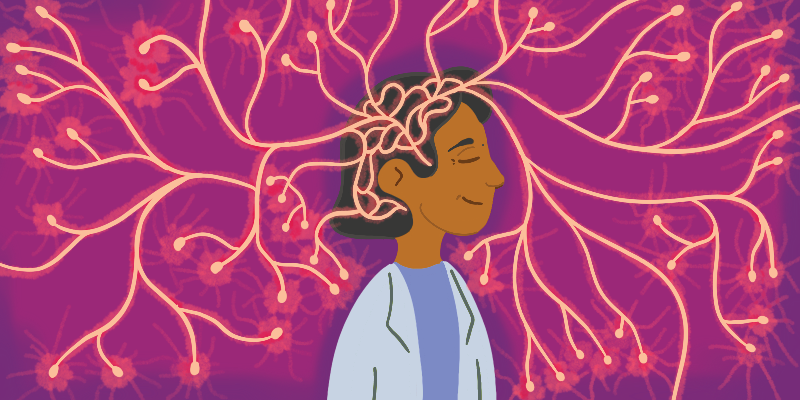
Think back to a time when you were learning something new.
If you’re looking back from the mastery point of view, odds are your brain has filtered out a big feeling that goes along with learning: discomfort.
The uncertainty within growth cannot be allowed to derail our progress. In fact, discomfort is a sign you’re in the midst of learning. However, plucking up the courage required to both face down uncertainty and soldier forth unabashedly takes tons of energy and effort.
How do school administrators ask burnt-out educators for more when all that’s left is less? How do administrators themselves reach into the depths of burnout to find a long-cold spark of learning? The answer lies in the neuroscience of how our brains grow.
Myelin is in the eye of the beholder
We know practice makes perfect, but on the physical level what does that really look like? The star of our show is a fatty substance cocooning our neural connections called myelin. This is the “white matter” of our brain, and it serves an important purpose: speed.Neurons (brain cells) connect as we learn, and our brain wants to cement it. Our brains like to create paths (axons) they can revisit later without thinking too much about it. This is how habits are formed and how automaticity happens—whether it’s exercise or math facts or nail biting, your impulses are thanks to a thick layer of myelin protecting your neural networks. Myelin conducts the electrical impulses firing your neurons at top speed, hurtling through the axons connecting neurons inside your brain.
Without those neurons wiring and firing together, learners are the opposite of sharp and savvy. Instead, they’re stumbling through the basics like newborn foals, tumbles and all.
Confronting the cocoon of myelin memory
We forget in our roles as expert coaches just how off-putting not knowing feels.We are also encouraged to equate speed with success. Even though you wouldn’t rush through rock climbing or knife throwing or forklift certification.
So why speed through becoming incredibly proficient in any new pursuit?
The external pressures aside, a call is also coming from inside the house. “Wait!” the brain wails. “We already have protocol for this. We already know it. Why change?”
And that’s the brain’s job. We cannot fault it. It made all this myelin, and for what? For you to decide to change?
And so we come to a meta-moment in learning as expert coaches. The decision to fly the coop, leave the myelin cocoon we’ve made, and embark on a new migration toward something different.
Deliberately developing cortical connections
Now. We know the brain’s modus operandi, and we know it’s flawed. We cannot always trust that our myelin is worth protecting forever and ever. Sometimes the brain is choosing the familiar path over the worthwhile challenge.Enter neuroplasticity.
The American Psychological Association (APA) defines neuroplasticity as “the ability of the nervous system to change in response to experience or environmental stimulation.”
Up until the 1970s, scientists thought neuroplasticity ended with childhood. Now, we theorize that brains of all ages are capable of rearranging their synapses, whether following an injury or simply learning something new.
“What if adulthood is one very long summer slide?” Dr. Rachel Wu explored this idea in relation to our aging population. Neuroscientists found that folks who accepted negative ideas about aging shape their lives accordingly. What might happen if adults take an active role in their own learning (neuroplasticity) instead?
Brain science is on our side even in adulthood. The novelty of learning something new activates the midbrain’s motivation motor. It may even release dopamine in the brain. All great news for lifelong learning: the brain—contrary to historical belief—is wired to chase new information, to be delighted with learning, and to create and protect new pathways.
To longevity—and beyond
For all its prickly inconvenience, learning something new fortifies our neural networks and builds new ones. Pushing your brain to learn something new can literally boost longevity.Researchers at the Salk Institute completed a first-of-its-kind study in which they observed the development of new neurons in adult brains (of mice). They found new brain cells undergo a period of overgrowth—that is, they create more synaptic connections than they need and then return to prune the connections.
This process, called synaptic pruning, removes underused connections in the brain to free up working memory, improve energy use, and make thinking and processing easier. Interestingly, neurodivergent brains may undergo synaptic pruning less often than typical brains, which can lead to sensory and cognitive overload.
For most people, synaptic pruning starts in late adolescence and continues throughout life. The reference to pruning plants goes far beyond the visual similarities between dendrites (neural branches). Snipping back the branches of plants can help them grow stronger and hardier. The Salk Institute study shows that even brand-new adult neurons (remember: we didn’t think those existed just 50 years ago) undergo the process of overgrowth and pruning in the same spirit of cognitive strength and efficiency.
What will you learn today? Take care and enjoy the myelin slide ride.
If you enjoyed this article about cognition, you’ll love reading about student metacognition.
WHAT'S NEXT FOR YOUR EDTECH? The right combo of tools & support retains staff and serves students better. We'd love to help. Visit skyward.com/get-started to learn more.

|
Erin Werra Blogger, Researcher, and Edvocate |
Erin Werra is a content writer and strategist at Skyward’s Advancing K12 blog. Her writing about K12 edtech, data, security, social-emotional learning, and leadership has appeared in THE Journal, District Administration, eSchool News, and more. She enjoys puzzling over details to make K12 edtech info accessible for all. Outside of edtech, she’s waxing poetic about motherhood, personality traits, and self-growth.