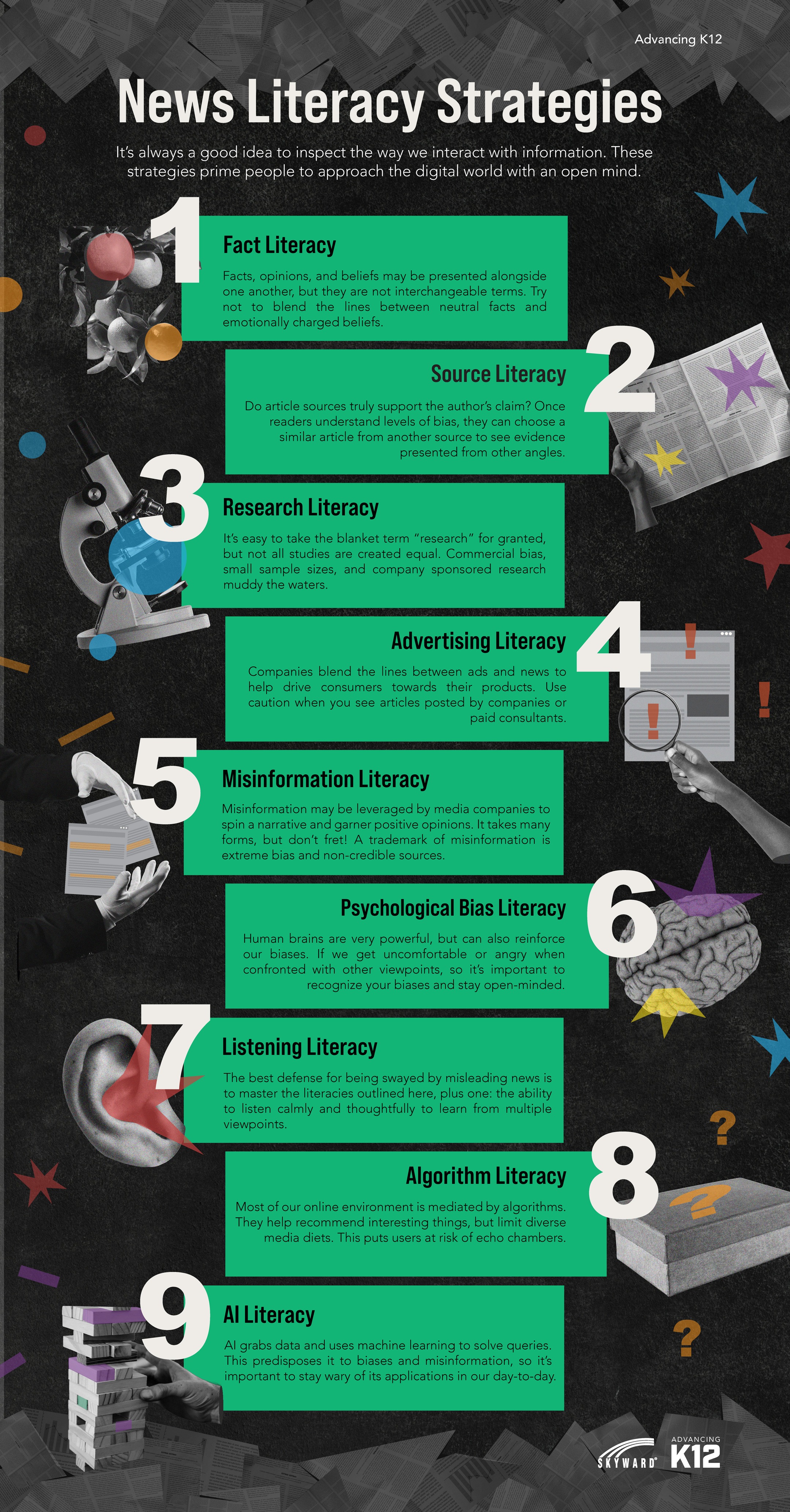
1. Fact Literacy
Don’t let quick changes in media trends blend the lines. Facts, opinions, and beliefs may be presented alongside one another, but they are not interchangeable terms.Facts are verifiable statements validated through science, historical observation, and other primary sources. They strengthen an argument by providing evidence, but by their nature do not carry a bias. Facts need context to have value.
Opinions are personal judgments based on available evidence, though they cannot be verified like facts. They don’t (or shouldn’t) hold as much weight in an argument. Opinions are changeable once someone considers different evidence, and opinions can betray a bias.
Beliefs are based on culture, faith, morals, or values rather than fact. These statements may be more emotionally charged and biased than opinions.
Core beliefs are the deepest beliefs there are. These are very hard to change and invoke the strongest emotional response when someone tries.
Legitimate publishers are more likely to place indicators on their opinion pieces. Less scrupulous publishers may present opinions (or even beliefs) as facts, which makes learning to decode these different statements even more important. Headlines are not guaranteed to be a strong source of facts, since they are often written to get people to click—not always to inform or summarize the facts in the story. Always read the entire story to get the facts.
Red flags:
🚩 First-person language (“I,” “me,” “my”)
🚩 Inflammatory statements
🚩 Rough or attacking language not quoted from a person
🚩 Lack of supporting citations
🚩 Outwardly displaying or hinting at bias
2. Source Literacy
The validity of facts is only as strong as the sources they come from, but how do you know a source is trustworthy? A good first step is to read the whole article before looking to the sources it provides.Do the sources truly support the claim, or are they simply links to sites related to the idea? Is any of the evidence actually an opinion or belief masquerading as fact? Keep an eye out for spelling and grammatical errors—of course, typos occasionally slip by editors’ eyes, but most credible sources will have a firm grasp on their language quality.
Different media outlets and their parent companies have biases. Readers can square this by conducting opposition research. Choose an article about the same topic from a different news source to see the evidence presented from a different angle. If in doubt, check out the publication's about page and the author’s bio to detect any hidden biases. A quick way to determine a story’s validity is to consult a fact-checking website. There are several, including FactCheck.org, PolitiFact.com, and Snopes.com. This is just the tip of the verification iceberg, though.
Red flags:
🚩 Bias stated or implied in author and about us pages
🚩 Posting clickbait to boost ratings
🚩 Untrustworthy, unrelated, or biased sources (or no sources at all)
🚩 Failing a fact check
🚩 Being unable to find other sources reporting on the claim to verify it (too good to be true)
🚩 Lots of editing errors
🚩 Broken links
3. Research literacy
In the information age there’s a popular phrase to “do your own research,” but it’s important to remember that not all research studies are created equal. Some things that effect the credibility of a research study to a topic area include:- Sample size (N): A small sample size makes a study harder to apply to the general population. When more subjects are in a study, they more accurately represent a cross-section of people.
- Randomized study subjects: When scientists randomly select subjects for their sample, it reduces bias in who participates in a research study and better represents the target population. Say you select 50 students for a school-wide survey but only select students in the 8th grade. This non-random sample will skew your survey results and make your study less relevant to the school population.
- Who conducted the research? Take a deep dive into the organization behind the research. What are their affiliations? Have any of the researchers ever held positions with the company funding the research? How many times has their work been cited by other researchers and publications?
- Who paid? Follow the money to uncover any funding biases masquerading behind layers of organizations.
Even if the study is conducted soundly, news media can misrepresent or misinterpret the findings of the study. It’s important for readers to look at the study themselves and consider how publications use the research to support their stance, whether its fact-based or opinion-based.
Red flags:
🚩 Small sample size
🚩 Researchers paid by or otherwise sponsored by companies
🚩 No clear link to the actual study’s results
4. Advertising Literacy
We spend a lot of time online, and companies know it. They will create ads that mimic the online environment, blending the lines between news feeds and advertisements. This is known as native advertising.Companies also create and share relevant media to attract and retain a consumer audience, positioning themselves as a trustworthy partner. When the audience is looking to make a purchase, they’ll be more likely to buy from the companies who use content marketing: familiarity, trust, and the feeling they’ve already “got something” from the useful content the brand produces.
Algorithms track browsing history to suggest interesting topics to specific viewers, which helps companies increase sales by leveraging relevant articles they produce.
**Editor's note: We've always tried to be transparent about the fact that Advancing K12 is the content brand for Skyward. When done well, content marketing is never about trying to manipulate or steer readers in a certain way—it should be about providing value to the audience. Your readership boosts the credibility of our website in the eyes of search engines, with the natural result being more traffic everywhere (including the product-heavy pages).
Red flags:
🚩 Anything sponsored by a company
🚩 News stories link to retail sites
🚩 Paid "consultants" as authors
5. Misinformation Literacy
There are a few different kinds of misinformation, but all are worth being wary of. To know how to identify misinformation, it helps to understand why it exists in the first place.Return on investment: For companies, it’s all about the bottom line. If a company can control the narrative and the messaging readers consume, it may be able to skew sales in a positive light. This includes boosting positive opinion and cushioning the blow of negative coverage.
Division: By exploiting specific biases, people may work to deepen political divides, create smokescreens, and generally draw the collective attention away or toward a specific narrative. People who take part in these campaigns are called trolls.
Misinformation can range from satire, which is a sometimes-subtle critique of a system or convention, to false connections and contexts, which intentionally misleads readers. The most severe instances of deceptive misinformation are manipulation and fabrication of content to manipulate readers.
Red flags:
🚩 Extreme bias
🚩 "News" sponsored by companies
🚩 Lack of credible sources
6. Psychological Bias
Literacy Human brains are so intelligent that they give us shortcuts in our thinking to help us make fast decisions (referred to as heuristics). While this is advantageous to knowing what food is safe to eat and which groups are safe to trust, it also biases our thinking. How so?These short cuts, which are informed by our values, experiences, and perceptions of risks and benefits, make it easy for us to accept information we already agree with, and harder to accept divergent information.
Confirmation bias refers to the tendency to interpret new evidence as confirmation of existing beliefs. Help fight this bias by conducting opposition research and learning to listen to understand, instead of automatically forming a rebuttal.
The backfire effect deals more with the intersection of facts and strongly held beliefs. When confronted with facts that challenge strongly held beliefs, people tend to hold even harder to their original belief, instead of changing it.
Red flags:
🚩 A desire to limit the opposing viewpoints encountered
🚩 Never encountering an opposing viewpoint organically (referred to as an echo chamber)
🚩 Experiencing strong emotional reactions to new information
And remember, everyone has biases. The important thing is to get to know your biases and pay attention to how they affect your perception of the content you consume.
7. Listening Literacy
The best defense for being swayed by misleading news is to master the literacies outlined here, plus one: the ability to listen thoughtfully to multiple viewpoints.Stay calm. It’s okay to feel uncomfortable—it’s what brains are biologically geared to do. The amygdala triggers a response when deeply held opinions are challenged.
Listen to learn. Instead of arguing immediately, digest the information and do some follow-up research. Form a rebuttal after calming down.
Actually learn. One of two things will probably happen: Something will inspire you to seek more evidence, and your opinion may change. Or, your original opinion may be upheld. Both are okay.
Red flags:
🚩 Feeling angry and lashing out during disagreements
🚩 Forgetting information and viewpoints shared with you, because your opinion is most correct
8. AI literacy
The modern web would not be what it is today without AI, yet most people don’t know exactly what this amorphous intelligence is. AI is a computer science which compiles data to solve problems, reason, and streamline its own programming. In other words, it can learn from data and the past to improve itself, which is where the term “intelligence” comes from. Understanding this is called AI literacy.Being AI literate makes it easier to spot its biases, critique its applications, and engage with it safely in our technological world. It also keeps readers sharp about AI generated misinformation.
Red flags:
🚩 Accepting information from AI sources without critical analysis
🚩 Depending on AI as sole source of problem solving
🚩 Avoiding public discourse about AI ethics and safety
🚩 Ignoring limitations and potential biases in AI software
9. Algorithm literacy
Algorithms aggregate data from our news feeds, search engine recommendations, and social media accounts. These algorithms are what conveniently recommend us content we like but also contribute to biases in our news media intake. When algorithms create news coverage bias for individuals, we are at risk of falling into echo chambers.Companies also leverage biased algorithms to recommend articles to readers to boost their sales and guide native advertising. But the codes which mediate algorithms are a black box that most consumers and experts don’t fully understand. So, it’s important to consume algorithmic content carefully. Readers can seek out a variety of sources for news media to avoid strong biases and reflect on how their algorithm impacts their news consumption.
Red flags:
🚩 Rarely encountering surprising, new, or opposing information
🚩 Forgetting, actively avoiding, or not thinking about your own biases
🚩 Avoiding or becoming enraged by reading information through the lens of “the other side(s)”
🚩 Underestimating the power of algorithms on your perceived reality
WHAT'S NEXT FOR YOUR EDTECH? The right combo of tools & support retains staff and serves students better. We'd love to help. Visit skyward.com/get-started to learn more.

|
Chloe Hansen Edtech Thought Leader |